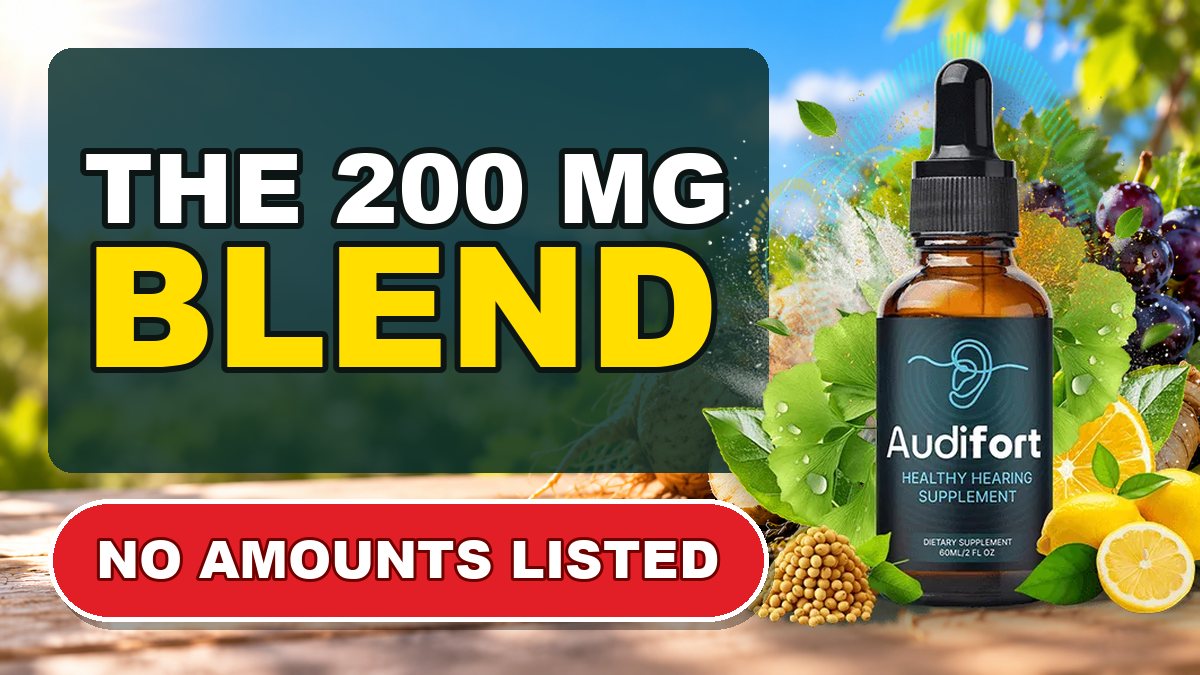
Audifort puts 22 ingredients under a single line, "Proprietary Blend 200 mg," and gives no amount for any one of them. That's allowed. The federal rule for Supplement Facts panels asks for the blend's total weight and for its ingredients in order from heaviest to lightest, and the Audifort label does both. You can rank the 22 items. You can't weigh them.
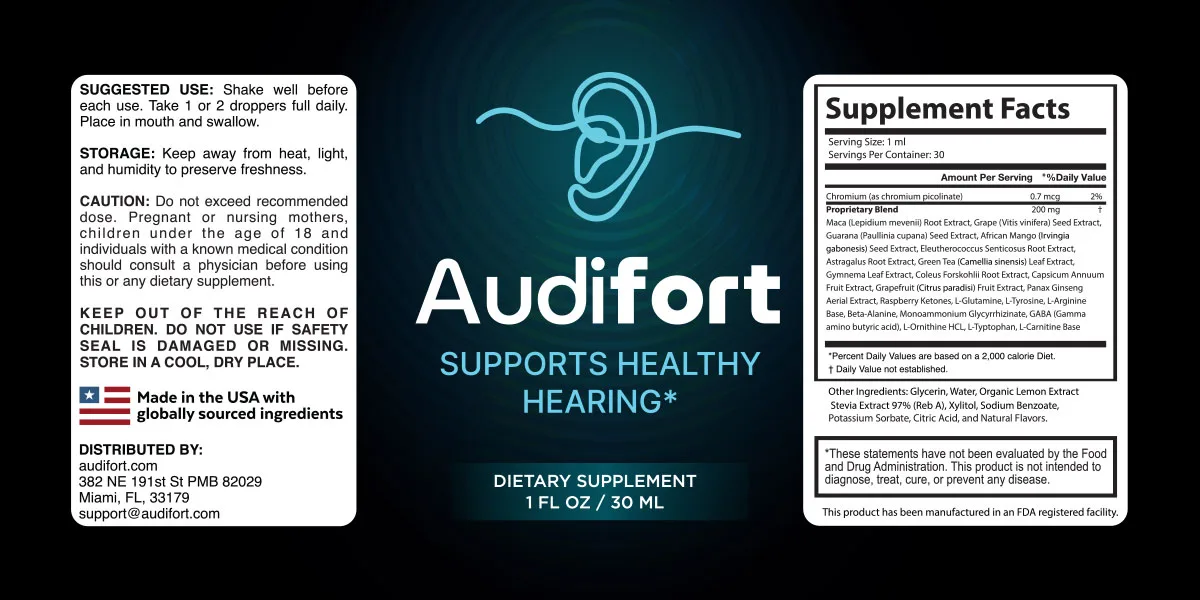
What is a proprietary blend on a supplement label?
It's a group of ingredients listed together under one name, with one weight. The rule is 21 CFR 101.36(c). It says the blend is identified by the term "Proprietary Blend" or another descriptive or "fanciful name," and then spells out what has to appear:
- The ingredients in the blend are "declared in descending order of predominance by weight" (paragraph (c)(2)).
- The amount printed is "the total weight of all other dietary ingredients contained in the proprietary blend" (paragraph (c)(3)).
- A symbol next to that amount points to the footnote "Daily Value not established."
"Other dietary ingredients" is the FDA's term for ingredients that have no Daily Value. The agency's labeling guide for supplements also says that ingredients which do have a Daily Value must be listed separately with their own weights. That explains the chromium line on Audifort: 0.7 mcg, 2% of the Daily Value, sitting above the blend.
| What the rule asks for | What the Audifort label shows |
|---|---|
| A name such as "Proprietary Blend" | "Proprietary Blend," in bold |
| Total weight on the same line | 200 mg per 1 ml serving |
| Blend ingredients listed heaviest first | 22 names, maca root first, L-carnitine base last |
| Symbol tied to "Daily Value not established" | A dagger, with that footnote under the panel |
| Ingredients with a Daily Value listed on their own | Chromium, 0.7 mcg, 2% |
| Weight of each blend ingredient | Not asked for in paragraph (c), and not given |
Why are the amounts of each ingredient unknown?
Because the rule lets them stay that way. An "other dietary ingredient" listed on its own gets a weight per serving under paragraph (b)(3)(ii). Put the same ingredient inside a blend and the label only owes you the blend's total. A company can keep its recipe private and still print a lawful panel. The catch for you is that nobody reading the bottle can tell whether the 200 mg is mostly maca or spread thin across all 22.
The FDA doesn't fill the gap. Its dietary supplement Q&A says the agency runs no tests on supplements ahead of sale, and that by law it does not approve supplements or their labeling.
What does the order of the list reveal?
More than it looks. Since the list has to run heaviest to lightest, each position puts a ceiling on weight. Take the 12th item, Panax ginseng. The 11 items above it each weigh at least as much as it does, so the first 12 together weigh at least 12 times the ginseng. All of that has to fit inside 200 mg. So the ginseng can't be more than 200 divided by 12, which is 16.67 mg per dropper. The same logic caps every item at 200 divided by its place in line.
Our calculation, not the real amounts. If the label lists blend items heaviest first, as 21 CFR 101.36(c)(2) requires, the item in position k can weigh at most 200 mg divided by k. Rounded to two decimals.
| Label position and ingredient | Upper limit |
|---|---|
| 1. Maca root | 200.00 mg |
| 2. Grape seed | 100.00 mg |
| 3. Guarana seed | 66.67 mg |
| 4. African mango seed | 50.00 mg |
| 5. Eleutherococcus root | 40.00 mg |
| 6. Astragalus root | 33.33 mg |
| 7. Green tea leaf | 28.57 mg |
| 8. Gymnema leaf | 25.00 mg |
| 9. Coleus forskohlii root | 22.22 mg |
| 10. Capsicum fruit | 20.00 mg |
| 11. Grapefruit fruit | 18.18 mg |
| 12. Panax ginseng aerial | 16.67 mg |
| 13. Raspberry ketones | 15.38 mg |
| 14. L-glutamine | 14.29 mg |
| 15. L-tyrosine | 13.33 mg |
| 16. L-arginine base | 12.50 mg |
| 17. Beta-alanine | 11.76 mg |
| 18. Monoammonium glycyrrhizinate | 11.11 mg |
| 19. GABA | 10.53 mg |
| 20. L-ornithine HCl | 10.00 mg |
| 21. L-tryptophan | 9.52 mg |
| 22. L-carnitine base | 9.09 mg |
Source: Audifort Supplement Facts label (October 2026) and 21 CFR 101.36; upper limits are our calculation. Dashed line: even split of 9.09 mg (illustration).
A few things follow, all assuming the label obeys the ordering rule. Maca root, at the top, weighs at least 9.09 mg, because the biggest share can't be smaller than the average. L-carnitine base, at the bottom, weighs at most 9.09 mg. Guarana seed extract, third in line, tops out at 66.67 mg per dropper; how much caffeine that extract holds is a separate unknown, which our caffeine page takes up.
The ginseng cap is the one we find most telling. The tinnitus study we reviewed for this site gave two groups of patients 1,500 or 3,000 mg of Korean red ginseng a day (Kim 2015), and 3,000 mg is at least 180 times the most Panax ginseng one Audifort dropper could hold. Our ginseng study page covers that comparison in full.
What would an even split look like?
This is an illustration only, since the real split isn't published. If the 200 mg were shared equally, each of the 22 items would get 9.09 mg (200 divided by 22). The label allows one or two droppers a day, so at two droppers the same illustration gives 18.18 mg per item per day.
We use the even split to show scale and nothing more. The real recipe could sit close to it or lean hard toward maca and grape seed. The label is consistent with both, and the chart above shows how much room there is.
- 200 mg
- total blend weight per 1 ml dropper
- 22
- ingredients sharing that 200 mg
- 9.09 mg
- each item in an even split (illustration)
- 18.18 mg
- the same illustration at 2 droppers a day
Source: Audifort label, October 2026. Example figures are our calculation and assume an equal split, which the label does not state.
From $49 a bottle · free US shipping on 3 and 6 packs
See the 2, 3 and 6 bottle packs →We earn a commission if you buy through this link.
Can you find out the real amounts?
Not from the bottle. The same FDA Q&A says consumers may contact the manufacturer or a commercial laboratory for an analysis of a product's content, and the Audifort label prints a support email. The seller doesn't have to share its recipe, and a lab test isn't free. If you want the full list of 22 names with their plant parts, it's on our ingredients page.
So the maker commits to one number for the whole blend: 200 mg. Everything printed after it is a ranking. A ranking can tell you the most any one ingredient could be, and that is where this label stops.
From $49 a bottle · free US shipping on 3 and 6 packs
Go to the official Audifort order page →We earn a commission if you buy through this link.