A 2015 pilot trial from Korea gave 61 adults with chronic tinnitus either Korean red ginseng (1,500 or 3,000 mg a day) or ginkgo extract (160 mg a day) for four weeks. Only the 3,000 mg group improved on the Tinnitus Handicap Inventory, a questionnaire about how much tinnitus gets in the way of daily life. Ratings of how intense the sound felt did not change significantly in any group.
Audifort lists Panax ginseng as one of 22 items in a 200 mg blend, so the trial says little about the product.
How the trial was set up
Tae Su Kim, Hwan Seo Lee and Jong Woo Chung published it in the Journal of Audiology & Otology in September 2015. Per the abstract on PubMed, they reasoned that reactive oxygen species damage inner ear cells and that red ginseng has an anti-ROS effect. It was an open-label randomized controlled trial with three groups. Fifty-nine of the 61 patients finished.
Open-label matters here. The full paper says patients and physicians knew which arm each person was in; only the statistics were done blind.
| Group | Daily dose | Length | THI score | VAS intensity rating | SF-36 quality of life |
|---|---|---|---|---|---|
| Ginkgo biloba extract (control) | 160 mg | 4 weeks | No significant change | No significant change | No significant change |
| Korean red ginseng, lower dose | 1,500 mg | 4 weeks | No significant change | No significant change | No significant change |
| Korean red ginseng, higher dose | 3,000 mg | 4 weeks | Significant improvement | No significant change | Role emotional and mental health scores improved |
For THI and SF-36 the abstract reports only the 3,000 mg group; the other two rows come from the full text.
Which scores moved and which did not
Here the Tinnitus Handicap Inventory has 25 items scored 0 to 100, with higher scores meaning more handicap. People on 3,000 mg a day scored significantly better at the end than at the start. The 1,500 mg group and the ginkgo group did not.
The Visual Analogue Scale was a 0 to 10 rating of tinnitus intensity, scored by the patients. No group changed significantly on it. So the high-dose group reported less handicap from tinnitus but did not rate the sound as quieter. The authors also tested hearing at the first and last visits and found no difference.
On the SF-36 health survey, the high-dose group improved on two scales, role emotional and mental health. The authors read this as ginseng helping the quality-of-life side of tinnitus "rather than having direct effects on the hearing." Their abstract ends cautiously, saying red ginseng may improve tinnitus symptoms and mental wellbeing.
What the authors say about the limits
The paper names its own weak spots. It was open-label, and red ginseng is a well-known health food in Korea, so people who expected it to work may have felt better partly for that reason. Ginkgo was meant as a positive control, and it showed no benefit. The authors also write that each group had too few patients.
Two more things follow from the design: there was no placebo group, and treatment lasted four weeks. That fits what NCCIH says of Asian ginseng research in general: most clinical trials have had fewer than 200 participants and lasted under 3 months.
How Audifort's ginseng compares with the study dose
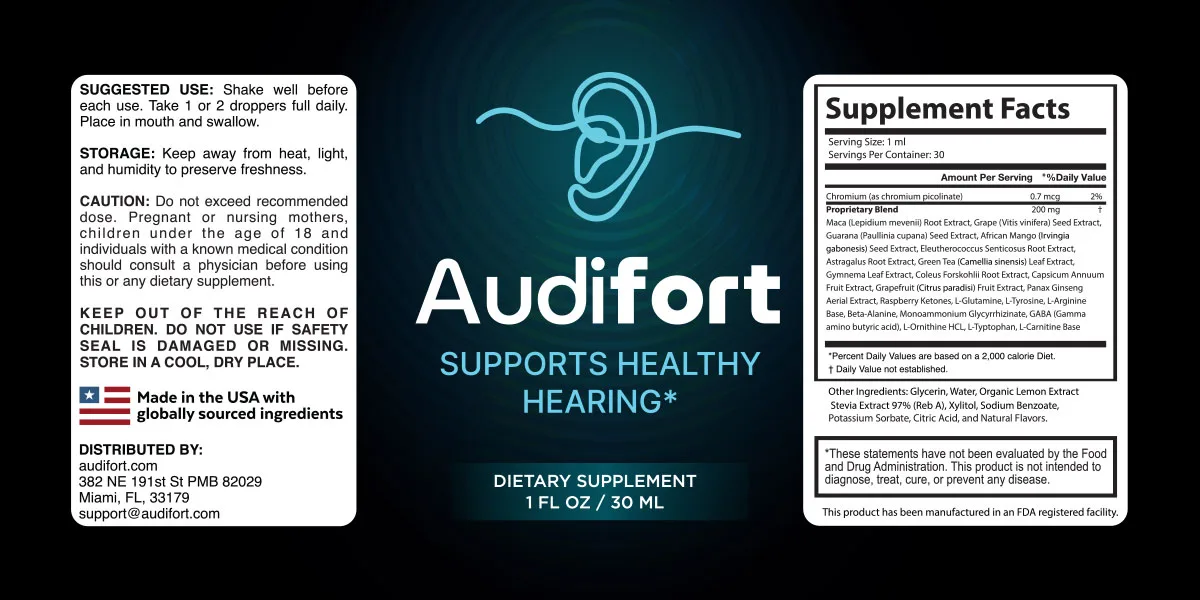
The Audifort label lists Panax ginseng aerial extract inside a 200 mg proprietary blend per 1 ml serving. It gives no amount for ginseng or any other blend item, and our proprietary blend page explains why.
The plant material differs as well. The study used red ginseng, which the authors describe as root dried after steaming. Audifort's label names the aerial parts, the plant above the ground, while NCCIH says the root is the part most often used for health purposes.
Example. The Audifort rows show the whole 22-item blend, not ginseng; the label does not say how much ginseng is in it. Assumes one dropper equals the 1 ml serving.
| Product and dose | mg per day |
|---|---|
| Korean red ginseng, 3,000 mg group | 3,000 mg |
| Korean red ginseng, 1,500 mg group | 1,500 mg |
| Audifort whole blend, 2 droppers (example) | 400 mg |
| Audifort whole blend, 1 dropper (example) | 200 mg |
| Ginkgo extract, control group | 160 mg |
Source: Kim et al. 2015, PubMed; Audifort label (200 mg blend per 1 ml serving, 1 or 2 droppers daily). Audifort rows are our calculation.
Example, for scale only. Pretend the whole blend were ginseng, even though 21 other items share those 200 mg. The study's 3,000 mg would still be 15 times one dropper. At two droppers, the label's upper direction, the blend totals 400 mg, and 3,000 mg is 7.5 times that. The 1,500 mg dose, which did not change THI scores, is 7.5 times a single serving. We assume one full dropper equals the 1 ml serving on the label.
Safety notes from NCCIH
NCCIH says short-term oral use of Asian ginseng, up to 6 months in recommended amounts, appears to be safe for most people. Trouble sleeping is the most common side effect. Severe rash, liver damage and severe allergic reactions are uncommon but have been reported. Ginseng may also worsen autoimmune disorders, interfere with blood clotting, lower blood sugar or interact with some medicines. Some studies suggest it may be unsafe during pregnancy.
Whether any of this applies at Audifort's amount is unknown, since the label gives none. The side effects page covers the other blend items that carry warnings.
What this means if ringing ears are why you are looking
The "Scientific References" list on the Audifort order page, as we read it in October 2026, does not cite this trial or any ginseng study. NIDCD is blunt about supplements in general: vitamins, herbal extracts and supplements are often advertised as tinnitus cures, and "none of these has been proven to be effective."
The Kim trial, then, is a four-week, unblinded study of 59 finishers on a large root dose. That makes a case for a bigger, blinded trial. It says nothing about what 1 ml of a 22-item blend does for tinnitus. Our Audifort and tinnitus page covers what NIDCD lists for easing symptoms and when to see a doctor.
NCCIH adds that if you have diabetes, you should check with your health care provider before using Asian ginseng. That holds for a blend containing it, whatever the amount.
From $49 a bottle · free US shipping on 3 and 6 packs
See the 2, 3 and 6 bottle packs →We earn a commission if you buy through this link.