
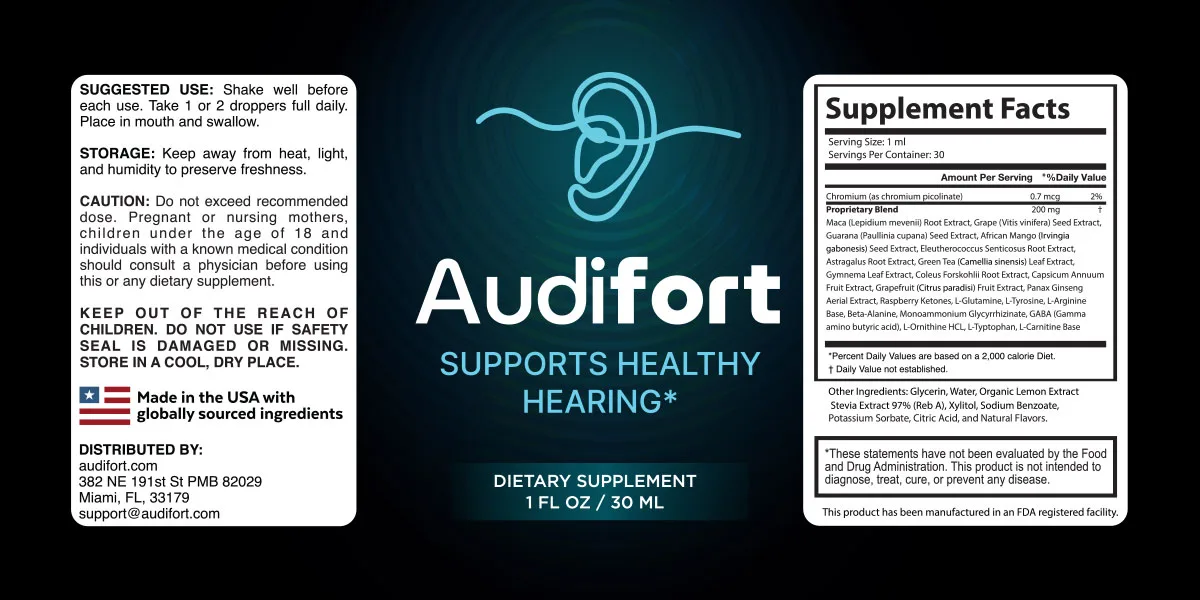
The Audifort bottle has a caution printed on it but no list of side effects. To fill that gap we went to federal health sources on the four blend ingredients that come with specific warnings: guarana and green tea, which bring caffeine, a licorice compound called monoammonium glycyrrhizinate, and Panax ginseng. Their notes describe each ingredient in general. The label doesn't say how much of any of them is in a dropper, so nobody can tell you how likely these effects are with Audifort.
Which Audifort ingredients have known side effects
All four sit inside the 200 mg proprietary blend, alongside 18 other items. Here is what the FDA and the National Center for Complementary and Integrative Health (NCCIH) report for each one.
| Ingredient on the label | What the source says | Source |
|---|---|---|
| Guarana seed extract | A possible caffeine source, per the FDA. Too much caffeine can push up heart rate and blood pressure, cause palpitations and disrupt sleep. | FDA |
| Green tea leaf extract | Contains caffeine. Green tea extract supplements can cause nausea, constipation, abdominal discomfort and raised blood pressure. Liver injury is uncommon and has mostly involved extract tablets or capsules. | NCCIH |
| Monoammonium glycyrrhizinate | Glycyrrhizin can cause irregular heartbeat and cardiac arrest, mainly in large amounts or with long use. Even small amounts have been linked to severe effects in some groups. | NCCIH |
| Panax ginseng aerial extract | Insomnia is the most common side effect. Severe rash, liver damage and severe allergic reactions have been reported but are uncommon. | NCCIH |
Caffeine from guarana and green tea
Two blend ingredients bring caffeine with them. The FDA lists guarana among ingredients that may have caffeine, and NCCIH says plainly that green tea does contain caffeine.
Overdoing caffeine shows up in ways most coffee drinkers will recognize: a racing or pounding heart, a jump in blood pressure, poor sleep, anxiety, the jitters, an upset stomach, nausea, a headache. That list comes from the FDA, which also points out that people vary widely in how sensitive they are to caffeine and how fast they clear it. Audifort gives no caffeine figure. Our page on caffeine in Audifort works out the most a dropper could hold and why the real amount is probably far below that.
NCCIH also flags drug interactions for green tea. At high doses it has lowered blood levels of nadolol, a beta-blocker. The extract can lower levels of the cholesterol drug atorvastatin, and an NCCIH-funded study found an interaction with raloxifene, an osteoporosis drug.
What the licorice compound can do
Monoammonium glycyrrhizinate is a glycyrrhizin salt made from licorice root extract. On NCCIH's licorice root page, glycyrrhizin is behind the most serious effects anywhere in this article: an irregular heartbeat and, at worst, cardiac arrest. Those are tied mainly to big amounts or use over a long stretch.
The sharper warning is about who takes it. According to NCCIH, people with hypertension, heart disease or kidney disease, and people with a heavy salt habit, have had severe reactions to glycyrrhizin even in small amounts. It also reports interactions between licorice and corticosteroids. Since Audifort doesn't state how much of the compound is in a serving, a person in one of those groups gets no reassurance from the label. We cover this in more depth on Audifort and blood pressure.
What NCCIH says about Asian ginseng
Panax ginseng is the Latin name NCCIH files under Asian ginseng. Its summary is fairly reassuring for short use: taken by mouth in recommended amounts for up to six months, it appears to be safe for most people. Insomnia is its most common side effect.
The less common reports are more serious, including severe rash, liver damage and severe allergic reactions. NCCIH also says Asian ginseng may worsen autoimmune disorders, interfere with blood clotting and might lower blood sugar, so people with diabetes should check with their provider first.
One detail is easy to miss. NCCIH says the root is the part most often used for health purposes, while Audifort's label specifies an aerial extract, made from the parts that grow above ground. NCCIH's safety notes are written about the herb in general, and none of them looks at this particular extract.
- 22
- ingredients share the proprietary blend, with no amount given for any of them
- 200 mg
- weight of the whole blend in one 1 ml dropper
- 1 or 2
- droppers a day under the directions on the bottle
- 6 months
- NCCIH: how long short-term Asian ginseng use appears safe for most people
Sources: Audifort Supplement Facts label, October 2026; NCCIH, Asian Ginseng.
Why the dose question has no answer
Several of these warnings depend on how much you take, and that is exactly what's missing. The Supplement Facts panel gives one weight, 200 mg, for all 22 blend ingredients together. Our page on the proprietary blend explains why the label can stop there.
The directions add another variable. The order page says to take one full dropper a day, but the bottle says one or two. At two droppers you get twice whatever is in the blend, including any caffeine, glycyrrhizin and ginseng. If you're worried about any of the effects above, staying at one dropper is the cautious reading of the label.
From $49 a bottle · free US shipping on 3 and 6 packs
See the 2, 3 and 6 bottle packs →We earn a commission if you buy through this link.
What to do if something feels wrong
For a reaction you think is serious, the FDA's instruction is to stop using the product right away and then file a report through its Safety Reporting Portal. Its list of serious reactions includes palpitations or irregular heartbeat, chest pain, fainting, shortness of breath and low blood pressure, along with hives or swelling of the lips, tongue or throat.
Smaller problems deserve attention too. If you're jittery in the afternoon or sleeping worse than usual, the FDA's advice is a conversation with a health care professional about how much caffeine you're getting, and that should include your coffee and tea as well as the dropper. If you would rather settle these questions before buying, our checklist of who should skip Audifort goes through them one situation at a time.