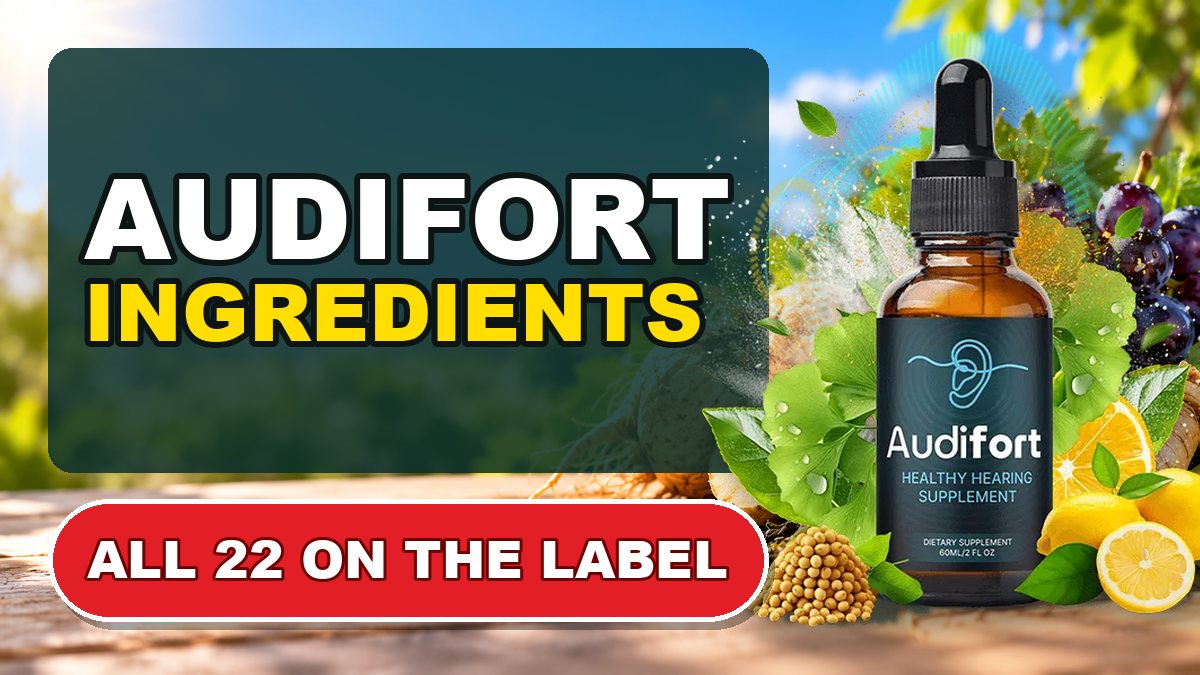
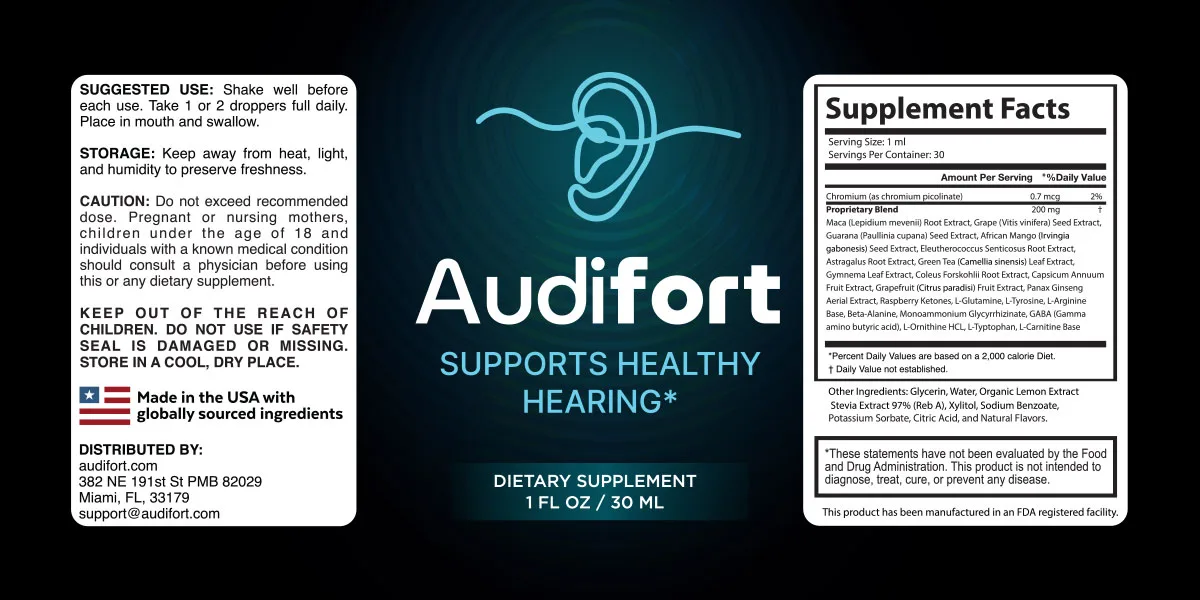
Each 1 ml serving of Audifort has 0.7 mcg of chromium plus a 200 mg proprietary blend of 22 ingredients: 12 plant extracts, 8 amino acids and related compounds, raspberry ketones and a compound made from licorice root. Nine more ingredients make up the liquid, and xylitol is one of them. Chromium is the only ingredient with its own amount printed on the bottle.
Which ingredient has an amount on the label?
Only one. The top row of the Supplement Facts panel reads "Chromium (as chromium picolinate) 0.7 mcg" with 2% in the Daily Value column. The math holds up: the Daily Value for chromium is 35 mcg for adults and children 4 and older, per the reference table in 21 CFR 101.9, and 0.7 divided by 35 is 2%.
That is a very small dose, so we treat chromium as a side note in this formula. The 22 blend items get no Daily Value at all. The label marks the blend with a dagger and adds the footnote "Daily Value not established."
- 0.7 mcg
- chromium per 1 ml serving, 2% of the 35 mcg Daily Value
- 200 mg
- total weight of the 22-item blend per serving
- 22
- blend ingredients, none with its own amount
- 9
- other ingredients in the liquid, xylitol among them
Source: Audifort label, October 2026; chromium Daily Value from 21 CFR 101.9.
What are the 22 ingredients in the blend?
Under the line "Proprietary Blend 200 mg" the label prints the 22 names below, and we kept its order. Federal labeling rules require blend ingredients to be listed from heaviest to lightest. So maca root is the biggest share and L-carnitine the smallest, but no single item has a weight. Our page on the 200 mg blend works through what that order does and doesn't reveal.
| # | Ingredient as printed | Type |
|---|---|---|
| 1 | Maca (Lepidium meyenii) root extract | Plant extract, root |
| 2 | Grape (Vitis vinifera) seed extract | Plant extract, seed |
| 3 | Guarana (Paullinia cupana) seed extract | Plant extract, seed |
| 4 | African mango (Irvingia gabonensis) seed extract | Plant extract, seed |
| 5 | Eleutherococcus senticosus root extract | Plant extract, root |
| 6 | Astragalus root extract | Plant extract, root |
| 7 | Green tea (Camellia sinensis) leaf extract | Plant extract, leaf |
| 8 | Gymnema leaf extract | Plant extract, leaf |
| 9 | Coleus forskohlii root extract | Plant extract, root |
| 10 | Capsicum annuum fruit extract | Plant extract, fruit |
| 11 | Grapefruit (Citrus paradisi) fruit extract | Plant extract, fruit |
| 12 | Panax ginseng aerial extract | Plant extract, aerial parts |
| 13 | Raspberry ketones | Other compound |
| 14 | L-glutamine | Amino acid or related |
| 15 | L-tyrosine | Amino acid or related |
| 16 | L-arginine base | Amino acid or related |
| 17 | Beta-alanine | Amino acid or related |
| 18 | Monoammonium glycyrrhizinate | Other compound (from licorice) |
| 19 | GABA (gamma amino butyric acid) | Amino acid or related |
| 20 | L-ornithine HCl | Amino acid or related |
| 21 | L-tryptophan | Amino acid or related |
| 22 | L-carnitine base | Amino acid or related |
The list falls into clean runs. Plant extracts hold positions 1 to 12, raspberry ketones come next, and the amino acids fill most of the bottom half, with the licorice compound at 18. Seven of the 12 extracts come from roots or seeds. Panax ginseng is the only one labeled "aerial," meaning the parts above ground. Keep that in mind if you read about the tinnitus study that tested Korean red ginseng, a different preparation, which our ginseng study page walks through.
Count of blend extracts by the plant part named on the Supplement Facts label. The label gives no weight for any of them.
| Plant part | Extracts |
|---|---|
| Root (maca, eleuthero, astragalus, coleus) | 4 |
| Seed (grape, guarana, African mango) | 3 |
| Leaf (green tea, gymnema) | 2 |
| Fruit (capsicum, grapefruit) | 2 |
| Aerial parts (Panax ginseng) | 1 |
Source: Audifort Supplement Facts label, read October 2026.
What does the order page say these ingredients do?
The order page singles out six of the 22 and gives each a job. These are the seller's words, summarized, and we have not tested any of them.
| Ingredient | Label position | What the order page claims |
|---|---|---|
| Maca root | 1 | Energy |
| Grape seed | 2 | Antioxidants that protect the ear |
| Green tea | 7 | Blood flow to the ears |
| Gymnema | 8 | Supports hearing |
| Capsicum | 10 | A healthy inflammatory response |
| GABA | 19 | Relaxation |
The front of the bottle says "Supports healthy hearing" with an asterisk. That asterisk leads to the standard line: the FDA has not evaluated these statements, and the product is not intended to diagnose, treat, cure or prevent any disease. Without per-ingredient amounts, there's no way to line any of these claims up against a research dose. That's the label's biggest gap, in our view.
From $49 a bottle · free US shipping on 3 and 6 packs
See the 2, 3 and 6 bottle packs →We earn a commission if you buy through this link.
What are the other nine ingredients?
Below the panel, the "Other Ingredients" line reads: glycerin, water, organic lemon extract, stevia extract 97% (Reb A), xylitol, sodium benzoate, potassium sorbate, citric acid and natural flavors. Glycerin and water come first, and since this list also runs heaviest to lightest, they are the two largest parts of the base.
Xylitol is a sugar alcohol sweetener. If a dog shares your home, it's the one to notice: the FDA warns it is dangerous for dogs. We cover what to do on the xylitol and dogs page.
Which ingredients come with a safety note?
Four of the 22 come with a warning in the government sources we checked:
- Guarana seed and green tea leaf both bring caffeine. The FDA's caffeine guide names guarana as a caffeine source and lists 37 mg for a 12-ounce green tea. The Audifort label states no caffeine amount.
- Panax ginseng is the species NCCIH calls Asian ginseng, and its fact sheet lists insomnia as the herb's most common side effect.
- Monoammonium glycyrrhizinate is made from licorice root, according to the FDA regulation on licorice and licorice derivatives. NCCIH's licorice root page says even small amounts of glycyrrhizin have been linked to severe adverse effects in people with high blood pressure, heart or kidney conditions, or a high salt intake. More on that in our licorice and blood pressure note.
If you take prescription medicine, show a pharmacist the label photo above and point to those four names, plus the grapefruit extract at position 11. The FDA warns that grapefruit juice lets more of some drugs into the blood. Nothing on the Audifort label says whether a grapefruit extract has the same effect. Your pharmacist can check that against the medicines you actually take.
From $49 a bottle · free US shipping on 3 and 6 packs
Go to the official Audifort order page →We earn a commission if you buy through this link.